Many writers wonder whether parentheses should come before or after a period. The confusion is understandable because the answer depends on whether the words inside the parentheses are part of a sentence or a complete sentence by themselves.
If you have ever paused while writing something like this (especially at the end of a sentence), you are not alone. In this guide, you will learn the exact rule for using parentheses and periods, see practical examples, avoid common mistakes, and remember the correct punctuation every time.
Parentheses Before or After Period? (Quick Answer)
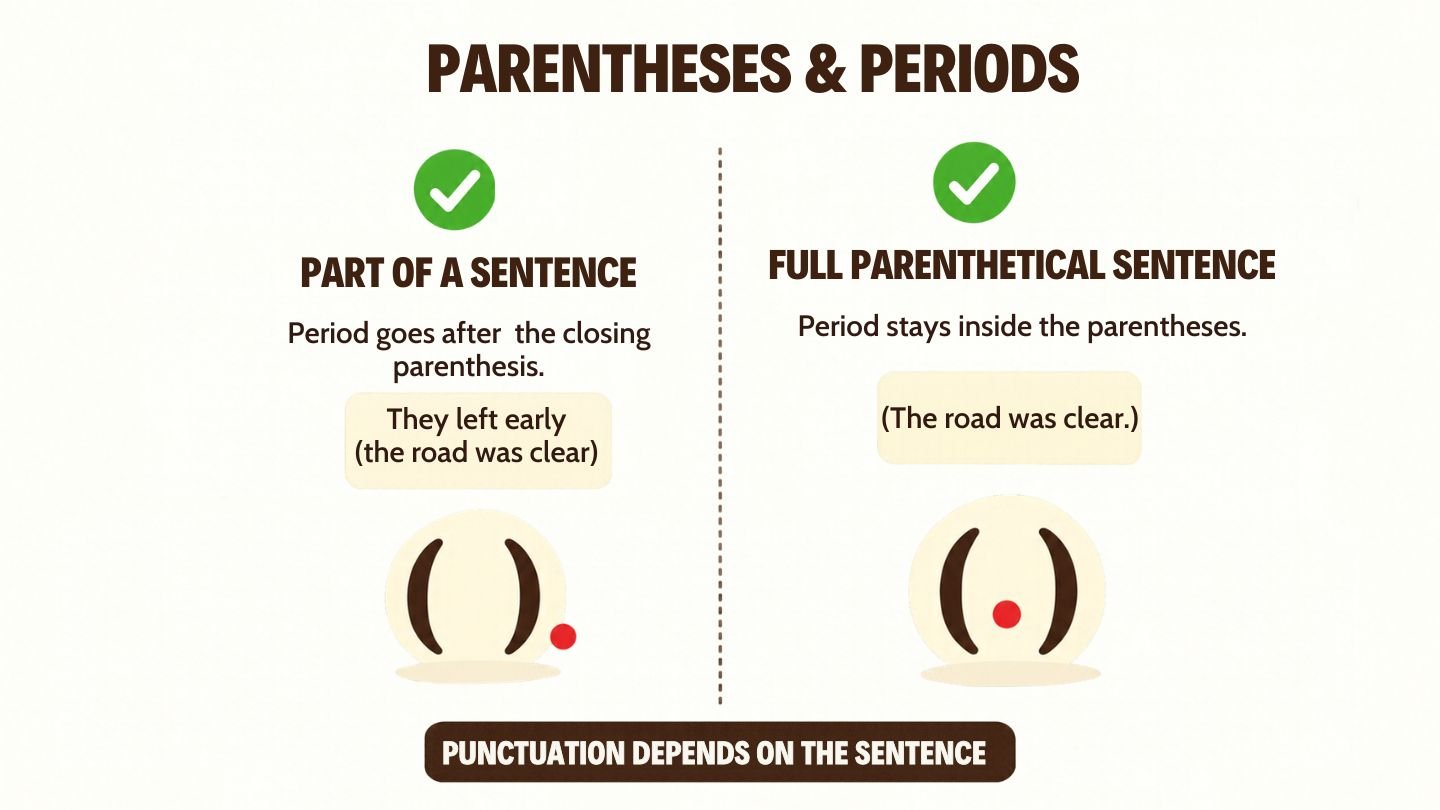
In most cases, the period goes after the closing parenthesis when the words inside the parentheses are part of the main sentence.
Correct:
- She bought a new laptop (for work purposes).
- We visited Paris (our favorite city).
If the text inside the parentheses is a complete sentence standing alone, the period goes inside the parentheses.
Correct:
- The project was delayed. (The manager approved a new timeline.)
Which One Should You Use?
The correct choice depends on how the parentheses are used:
- Use the period after the parenthesis when the parenthetical information is part of the sentence.
- Use the period inside the parenthesis only when the text inside the parentheses is a complete sentence that stands alone.
In everyday English writing, you will usually place the period after the closing parenthesis because most parenthetical phrases are not complete sentences.
Memorable takeaway: If the parenthetical text belongs to the sentence, the period stays outside.
Difference Table
| Feature | Period After Parenthesis | Period Inside Parenthesis |
| Meaning | Parentheses contain extra information | Parentheses contain a full sentence |
| Grammar | Part of the main sentence | Independent sentence |
| Usage | Most common | Less common |
| Context | Everyday writing | Formal explanations, notes |
| Frequency | Very frequent | Occasional |
| Example | She arrived late (because of traffic). | The event was canceled. (The weather was severe.) |
Meaning of Parentheses
Parentheses are punctuation marks used to add extra information to a sentence. The additional information is useful but not essential to the main meaning.
Common Uses of Parentheses
Writers use parentheses for:
- Extra details
- Dates
- Clarifications
- Definitions
- Abbreviations
- Examples
Examples:
- The meeting starts at 10 a.m. (local time).
- The company was founded in 1998 (over 25 years ago).
- NASA (National Aeronautics and Space Administration) launched the mission.
Parentheses help make writing clearer without interrupting the flow of a sentence.
Meaning of the Period
A period is the punctuation mark used to end a complete sentence.
Examples:
- The report is finished.
- We will meet tomorrow.
When periods and parentheses appear together, writers need to decide whether the information inside the parentheses belongs to the sentence or stands alone.
Why Do People Confuse These Rules?
People often confuse parentheses and periods because English punctuation changes depending on sentence structure.
Consider these examples:
- She left early (because she felt sick).
- She left early. (She felt sick.)
The words are similar, but the punctuation changes because the second example contains a complete sentence inside the parentheses.
Many people also assume punctuation always belongs inside parentheses, but that is not true in English.
Grammar Rule
Rule 1: Parenthetical Information Within a Sentence
When the information inside parentheses is only part of a sentence, place the period outside.
| Correct | Incorrect |
| We moved to Texas (last year). | We moved to Texas (last year.) |
| The event was successful (despite rain). | The event was successful (despite rain.) |
Rule 2: Complete Sentence Inside Parentheses
When the parenthetical text is a full sentence by itself, place the period inside.
| Correct | Incorrect |
| (The meeting has been canceled.) | (The meeting has been canceled). |
| We changed our plans. (The weather was terrible.) | We changed our plans. (The weather was terrible). |
American vs British English
American and British English follow the same rule for periods and parentheses.
Real-Life Examples
People
- Sarah moved to Chicago (for a new job).
- My brother (who lives in Canada) is visiting next month.
Nature
- The park has many birds (especially in spring).
- The river froze completely (because temperatures dropped).
Technology
- The software update fixed several bugs (including security issues).
- The app works on Android and iOS devices (with internet access).
Business
- Sales increased by 15% (compared with last year).
- The company opened a new office (in Dallas).
Everyday English
- I bought milk (and bread).
- We watched a movie (a comedy).
Common Mistakes
❌ I visited London (last summer.)
✅ I visited London (last summer).
Explanation: The information inside parentheses is not a complete sentence.
❌ The meeting ended early. (Everyone was tired).
✅ The meeting ended early. (Everyone was tired.)
Explanation: The text inside parentheses is a complete sentence.
❌ The event starts at 8 p.m. (Please arrive early).
✅ The event starts at 8 p.m. (Please arrive early.)
Explanation: The parenthetical sentence is complete.
❌ She bought a car (a used one.)
✅ She bought a car (a used one).
Explanation: The phrase is not a full sentence.
Easy Memory Trick
Remember this simple rule:
Part of a sentence = period outside.
Complete sentence = period inside.
Think of parentheses as a small room:
- If the sentence continues outside the room, the period stays outside.
- If the entire sentence stays inside the room, the period stays inside too.
Mini Quiz
1. Which sentence is correct?
A. We adopted a dog (last month.)
B. We adopted a dog (last month).
Answer: B
2. Which sentence is correct?
A. The train was late. (It was delayed by snow.)
B. The train was late. (It was delayed by snow).
Answer: A
3. Which sentence is correct?
A. She likes coffee (especially dark roast).
B. She likes coffee (especially dark roast.)
Answer: A
4. Which sentence is correct?
A. (The results will be announced tomorrow.)
B. (The results will be announced tomorrow).
Answer: A
Summary Table
| Situation | Correct Usage |
| Extra information in a sentence | Period after parenthesis |
| Complete sentence inside parentheses | Period inside parenthesis |
| Short explanation | Period outside |
| Standalone note | Period inside |
| Most everyday writing | Period outside |
| Formal side comment | Either, depending on sentence structure |
Frequently Asked Questions (FAQs)
Do parentheses come before or after a period?
Usually, the period comes after the closing parenthesis when the information inside is part of the sentence.
Do you put a period inside parentheses?
Only if the text inside the parentheses is a complete sentence.
Is this correct: “(Example).”?
Yes, if “Example” is a complete sentence. Otherwise, the period should go outside.
Can a sentence end with a parenthesis?
Yes. Many sentences end with parenthetical information, and the period usually comes after the closing parenthesis.
Do American and British English use different rules?
No. Both follow the same punctuation rules for periods and parentheses.
What about question marks and exclamation points?
Question marks and exclamation points follow similar rules. Their placement depends on whether they apply to the parenthetical text or the whole sentence.
Are parentheses common in formal writing?
Yes, but they should be used sparingly to avoid interrupting the flow of writing.
Is this rule important in academic writing?
Yes. Correct punctuation is especially important in essays, reports, and professional documents.
Conclusion
The rule for parentheses and periods is simpler than it first appears. In most sentences, the period goes after the closing parenthesis because the information inside is only additional detail.
Place the period inside the parentheses only when the parenthetical text forms a complete sentence on its own.
Remember this easy rule: If the words inside the parentheses belong to the sentence, the period belongs outside.

I am Daniel Brooks, a passionate English language writer specializing in grammar, vocabulary, spelling, and language education. I love breaking down complicated grammar concepts into simple explanations that readers can easily understand.
My goal is to help students, bloggers, and everyday English users improve their writing and communication skills. I create helpful articles about commonly confused words, correct spelling, sentence structure, punctuation, and English expressions.
In my free time, I enjoy reading educational books, exploring new words, and researching different aspects of the English language.
My Books:
- Mastering Everyday English Grammar
- The English Vocabulary Handbook
- Better Writing Through Better Grammar