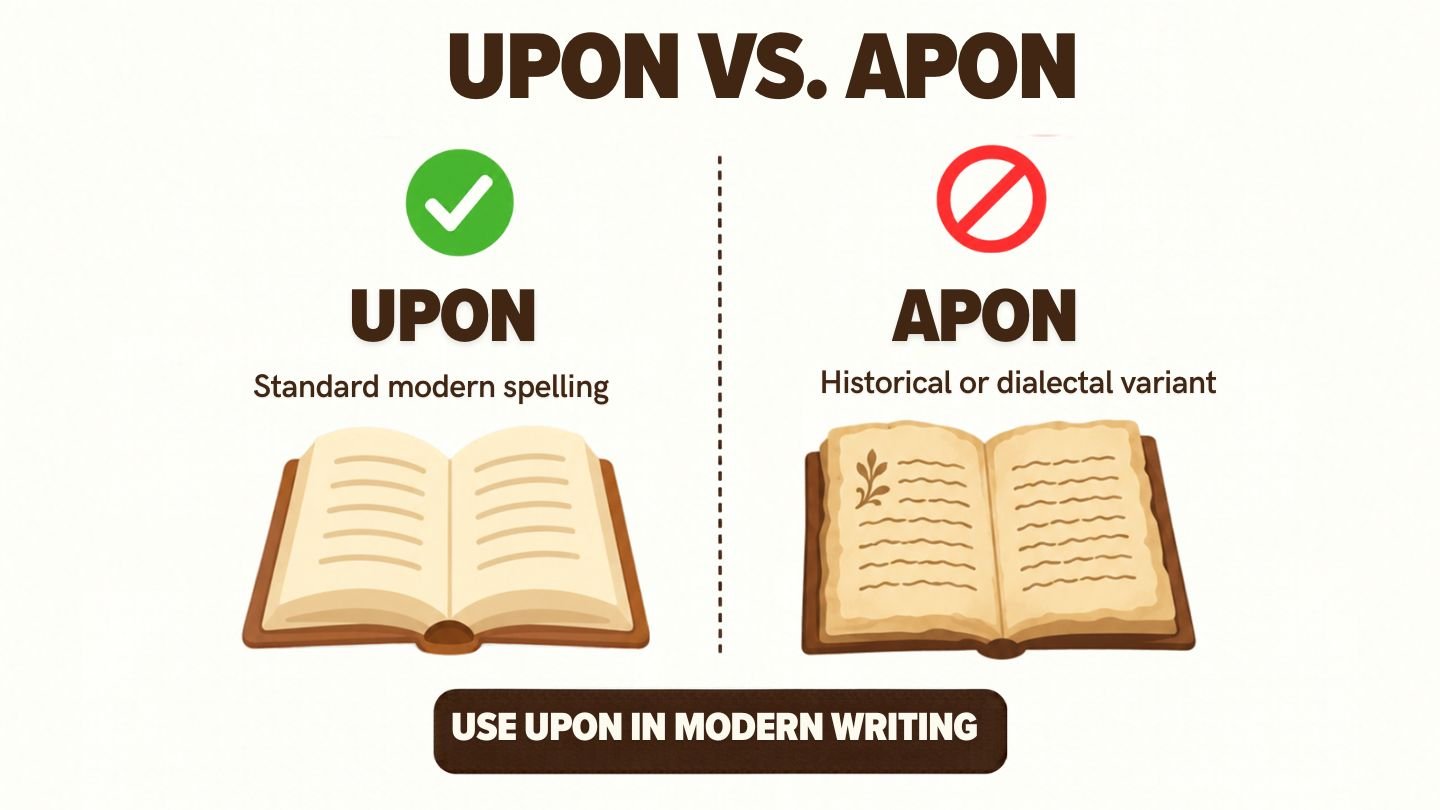
If you are wondering whether apon or upon is correct, the answer is simple: upon is the correct standard English word. Apon is generally a misspelling and should not be used in standard writing.
The confusion is understandable because upon is pronounced much like “uh-pon,” and some learners may spell it the way it sounds. In this guide, you will learn what upon means, how to use it correctly, why apon is wrong, and how to remember the correct spelling.
Quick Answer
Upon is the correct spelling in standard English. Apon is not a standard English word and is usually a spelling mistake.
- ✅ Upon arrival, please check in at the front desk.
- ❌ Apon arrival, please check in at the front desk.
Remember: When you mean on, after, or immediately when, use upon, not apon.
Which One Should You Use?
Use upon in standard English. It is a preposition that can mean on, after, or immediately following/when, depending on the sentence.
For example:
- Upon entering the room, she smiled.
= After or when she entered the room. - The book was placed upon the table.
= The book was placed on the table. - He acted upon my advice.
= He acted based on my advice.
Apon, by contrast, is normally an incorrect spelling of upon. If you see apon in ordinary English writing, it should generally be corrected to upon.
Memorable takeaway: Upon is correct; apon is a misspelling.
Difference Table
| Feature | Upon | Apon |
| Meaning | On, after, or immediately when | No standard modern English meaning |
| Usage | Standard English | Generally a spelling error |
| Grammar | Preposition | Not normally a standard English word |
| Context | Formal, literary, and everyday expressions | Should be avoided |
| Frequency | Common | Very uncommon as an English spelling |
| Everyday use | Correct | Incorrect |
Meaning of “Upon”
Definition
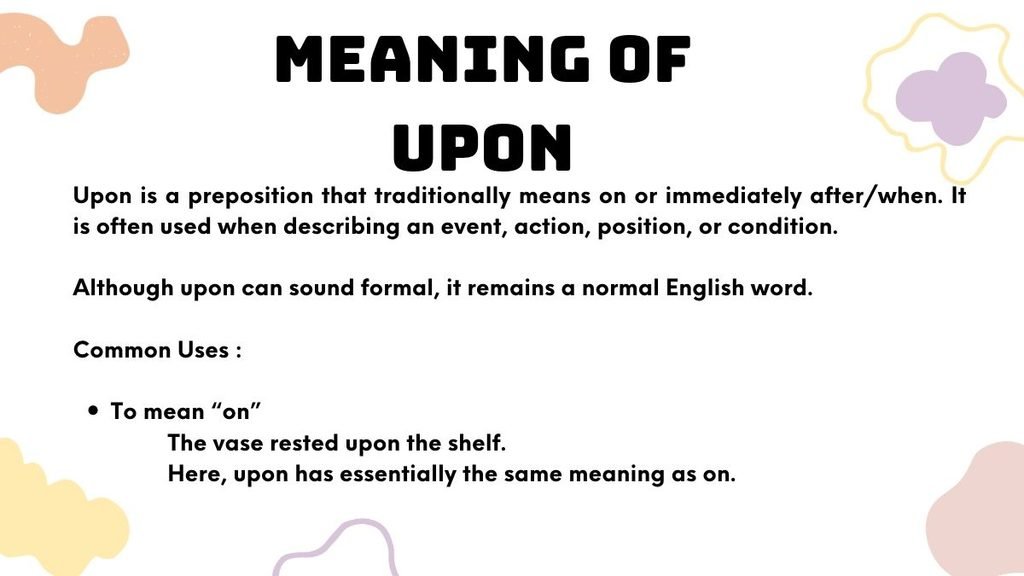
Upon is a preposition that traditionally means on or immediately after/when. It is often used when describing an event, action, position, or condition.
Although upon can sound formal, it remains a normal English word.
Common Uses
1. To mean “on”
The vase rested upon the shelf.
Here, upon has essentially the same meaning as on.
2. To mean “after” or “immediately when”
Upon arrival, please call me.
This means when you arrive or immediately after you arrive.
3. To mean “based on” or “as a result of”
The decision was made upon further review.
The decision was made after considering the additional review.
4. In established expressions
You may see upon in phrases such as:
- once upon a time
- upon request
- upon arrival
- upon completion
- upon consideration
- upon further review
- act upon
- depend upon
These expressions are especially common in formal, professional, and literary English.
Meaning of “Apon”
Is “Apon” a Word?
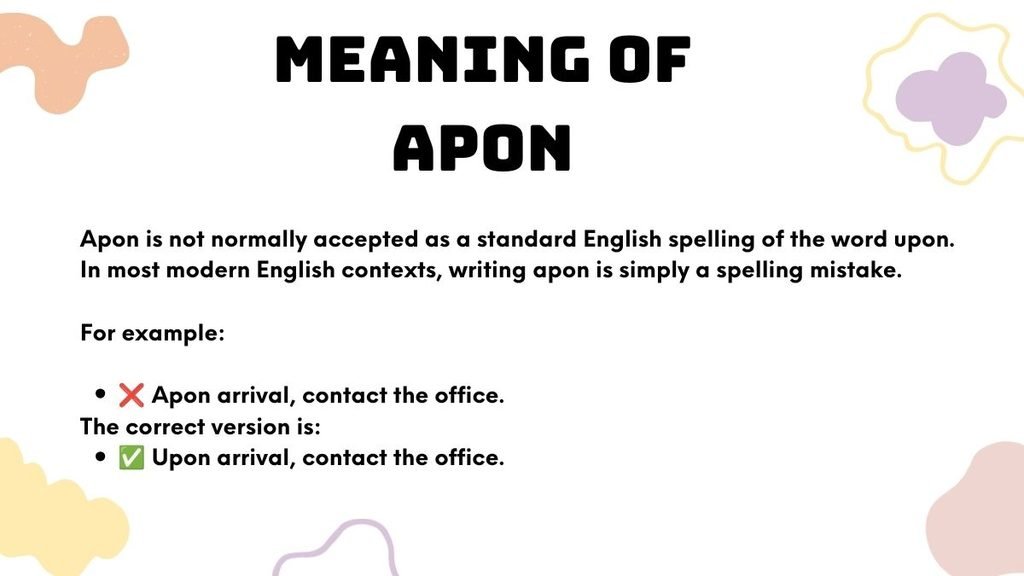
Apon is not normally accepted as a standard English spelling of the word upon.
In most modern English contexts, writing apon is simply a spelling mistake.
For example:
❌ Apon arrival, contact the office.
The correct version is:
✅ Upon arrival, contact the office.
Why Is It Uncommon?
The spelling apon may appear occasionally in historical texts, names, or specialized contexts, but that does not make it the appropriate spelling for ordinary modern English.
If you are writing an email, school assignment, article, business document, or social media post in English, use upon.
Why Do People Confuse These Words?
The main reason is pronunciation.
In normal speech, upon can sound like “uh-PON.” English learners sometimes write the word according to how they hear it and produce apon.
English has many spelling patterns that cannot be predicted perfectly from pronunciation. The safest approach is to learn the standard written form:
upon = U-P-O-N
Another reason for confusion is that upon is less common in casual speech than on. Someone who mostly hears phrases such as “upon arrival” in formal contexts may not immediately recognize its spelling.
Grammar Rule
The basic rule is straightforward:
| If you mean… | Use |
| on | upon can sometimes be used |
| after/immediately when | upon |
| in phrases such as “upon request” | upon |
| the standard spelling of this word | upon |
| “apon” as a normal English spelling | ❌ Avoid it |
Upon + Noun or Gerund
Upon is commonly followed by a noun:
Upon arrival, please wait outside.
It can also be followed by an -ing form:
Upon receiving the email, she called her manager.
This construction means when/after receiving the email.
A useful pattern is:
upon + noun
upon + -ing form
Examples:
- upon arrival
- upon completion
- upon receiving
- upon entering
- upon hearing
- upon returning
Real-Life Examples
People
Upon meeting his new teacher, James introduced himself.
She smiled upon seeing her old friend.
Nature
Upon sunrise, the birds became more active.
The flowers opened upon receiving enough sunlight.
Technology
The application sends a notification upon completion of the download.
The device restarts upon detecting a system error.
Business
Payment is required upon receipt of the invoice.
The company will review the application upon request.
Everyday English
Please call me upon arrival.
Once upon a time, there was a small village.
She changed her mind upon hearing the news.
In casual conversation, however, on or when is often more natural:
Upon arrival, call me. — More formal
When you arrive, call me. — More conversational
Common Mistakes
Mistake 1: Using “apon” instead of “upon”
❌ Apon arrival, please wait here.
✅ Upon arrival, please wait here.
Why? Upon is the standard spelling.
Mistake 2: Assuming “upon” is always more natural than “on”
❌ The keys are upon the kitchen table. — Grammatically possible, but unnecessarily formal in everyday conversation.
✅ The keys are on the kitchen table.
Why? On is usually the natural choice for ordinary physical locations.
Mistake 3: Using “apon” in formal writing
❌ Apon completion of the project, submit the report.
✅ Upon completion of the project, submit the report.
Why? Formal writing requires the standard spelling upon.
Easy Memory Trick
Think of upon as “UP + ON.”
The word contains ON at the end:
UP + ON = UPON
So when you are tempted to write apon, remember:
“Upon has ON in it.”
If you mean the standard English word, write UPON.
Mini Quiz
1. Which spelling is correct?
A. Apon
B. Upon
C. Appon
D. Upoon
Answer: B. Upon
2. Choose the correct sentence.
A. Apon arrival, call the receptionist.
B. Upon arrival, call the receptionist.
Answer: B. Upon arrival, call the receptionist.
3. Which sentence uses “upon” correctly?
A. She called me upon receiving the message.
B. She called me apon receiving the message.
Answer: A. She called me upon receiving the message.
4. Which word is usually better in casual conversation?
A. Upon
B. On
Answer: B. On
For example, “Call me when you arrive” sounds more natural in casual speech than “Call me upon arrival.”
Summary Table
| Situation | Correct choice | Example |
| Standard spelling | Upon | Upon arrival, call me. |
| “After/when” | Upon | Upon hearing the news, she left. |
| Formal expression | Upon | Payment is due upon receipt. |
| Casual physical location | On | The phone is on the desk. |
| Incorrect spelling | ❌ Apon | Do not write “apon arrival.” |
| Casual alternative to “upon” | On/when | Call me when you arrive. |
Frequently Asked Questions (FAQs)
Is “apon” a correct English word?
No, apon is generally not a correct spelling in modern standard English. In ordinary writing, use upon.
Is it “apon arrival” or “upon arrival”?
The correct phrase is “upon arrival.”
✅ Upon arrival, please report to the front desk.
It means when you arrive or immediately after arriving.
What does “upon” mean?
Upon can mean on, after, or immediately when, depending on context.
Upon arrival = when or after arriving.
Is “upon” formal English?
Upon can sound more formal than on or when, especially in phrases such as upon completion and upon request. It is completely standard English.
Can I use “upon” in everyday conversation?
Yes, but on or when is often more natural in casual conversation.
For example:
Formal: Upon arrival, call me.
Casual: When you arrive, call me.
Is “upon” the same as “on”?
Sometimes, but not always. Upon can replace on in certain contexts, particularly formal or literary ones. It also commonly means when or after, as in upon receiving the letter.
What is the opposite of “upon”?
There is no single direct opposite of upon. Its meaning changes according to context, so the appropriate opposite might be under, off, or something else.
Is “upon” American or British English?
Upon is used in both American and British English. There is no major regional spelling difference here. The spelling upon is standard in both varieties.
Conclusion
The correct choice between apon or upon is clear: upon is the standard English word, while apon is generally a misspelling.
Use upon when you mean on, after, or immediately when, especially in expressions such as upon arrival, upon request, upon completion, and upon receiving.
In casual English, you can often replace upon with simpler words such as on, when, or after. But when spelling the word itself, remember one rule:
Always spell it U-P-O-N: upon, not apon.

I am Daniel Brooks, a passionate English language writer specializing in grammar, vocabulary, spelling, and language education. I love breaking down complicated grammar concepts into simple explanations that readers can easily understand.
My goal is to help students, bloggers, and everyday English users improve their writing and communication skills. I create helpful articles about commonly confused words, correct spelling, sentence structure, punctuation, and English expressions.
In my free time, I enjoy reading educational books, exploring new words, and researching different aspects of the English language.
My Books:
- Mastering Everyday English Grammar
- The English Vocabulary Handbook
- Better Writing Through Better Grammar