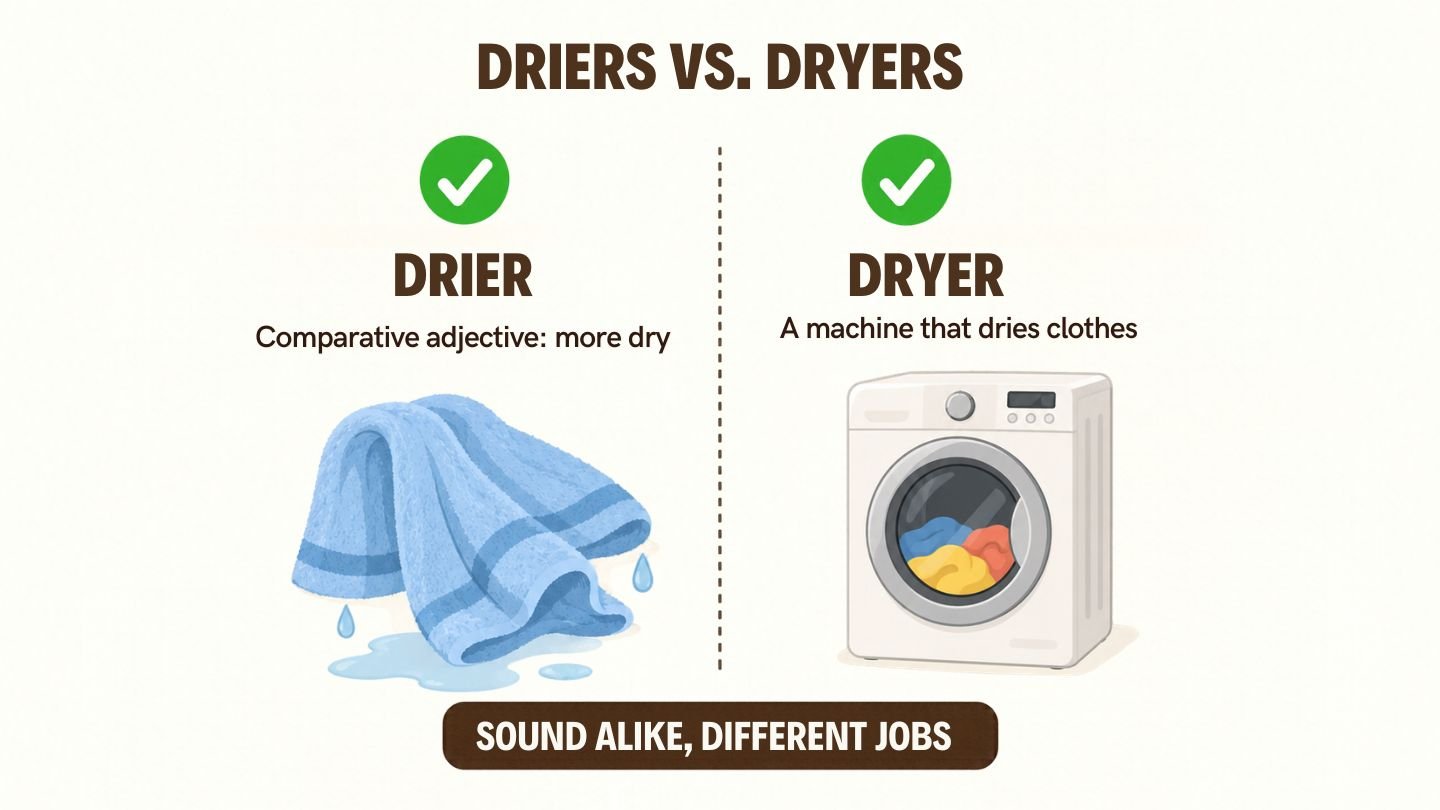
Driers and dryers are both real English words, but they are used in different ways. The confusion happens because drier is the normal comparative form of dry, while dryer is commonly used as a noun for a machine that removes moisture.
If you are talking about a clothes dryer, hair dryer, or hand dryer, use dryer. If you are comparing how dry two things are, drier is normally the correct choice: This towel is drier than that one.
This guide explains the difference between driers and dryers, when to use each spelling, common mistakes, American and British English usage, and an easy way to remember the difference.
Quick Answer
Drier is usually the comparative form of the adjective dry, meaning “more dry.”
Dryer is most commonly a noun meaning a machine or device used to make something dry.
- Correct: This shirt is drier than the other one.
- Correct: I put the clothes in the dryer.
- Correct: She bought a new hair dryer.
Easy rule: Use drier for “more dry” and dryer for a drying machine or device.
Which One Should You Use?
The correct word depends on what you mean.
Use drier when dry is being compared:
The desert air is drier than the air near the coast.
Use dryer when you mean a device or machine that dries something:
The clothes are in the dryer.
There is an important spelling detail here. Although dryer can occasionally be used as a comparative form of dry, drier is the traditional and widely preferred spelling for the adjective’s comparative form. In careful English writing, drier is the clearest choice when you mean “more dry.”
Memorable takeaway: Drier describes dryness; dryer usually describes a drying machine.
Difference Table
| Feature | Drier | Dryer |
| Meaning | More dry | A device that dries something |
| Grammar | Usually a comparative adjective | Usually a noun |
| Main use | Comparing dryness | Naming a drying appliance or device |
| Context | Weather, clothes, skin, air, food, surfaces | Laundry, hair, hands, equipment |
| Frequency | Common | Very common |
| Everyday example | “The towel is drier.” | “The towel is in the dryer.” |
Meaning of Word 1: Drier
Definition and Grammar Role
Drier is normally the comparative form of the adjective dry. It means that something has less moisture than something else.
For example:
This towel is drier than the one on the floor.
Here, drier compares two towels. One contains less moisture than the other.
The basic pattern is:
dry → drier → driest
Examples:
- The clothes are dry.
- These clothes are drier than those.
- These are the driest clothes in the load.
Common Uses of Drier
You can use drier to describe many things:
- Weather: The climate is drier in the west.
- Air: The indoor air feels drier in winter.
- Clothing: This shirt is drier than that one.
- Food: The cake became drier after being left uncovered.
- Skin: My skin feels drier during cold weather.
- Ground: The soil is drier after several weeks without rain.
In each case, drier means “more dry.”
Meaning of Word 2: Dryer
Definition and Grammar Role
Dryer is commonly a noun for a machine or device that removes moisture.
Some familiar examples are:
- clothes dryer
- hair dryer
- hand dryer
- food dryer
- shoe dryer
For example:
Please put the wet towels in the dryer.
Here, dryer names the appliance, not the condition of the towels.
Where Is “Dryer” Used?
The word appears frequently in everyday American English, especially when talking about laundry and personal-care appliances.
Examples:
My dryer stopped working.
She used a hair dryer after her shower.
The public restroom has an automatic hand dryer.
In British English, tumble dryer is especially common for the household appliance used to dry clothes. Hairdryer is also commonly written as one word in British English, although hair dryer is widely understood.
Is “Dryer” Ever an Adjective?
Yes. Dryer can also appear as a comparative form of dry, particularly in some usage traditions and contexts. However, drier is the standard and clearer choice when you mean “more dry.”
For example:
The climate is drier this year.
This avoids confusion with the noun dryer, which usually refers to an appliance.
Why Do People Confuse These Words?
The confusion comes from the fact that English uses both -ier and -yer spellings in words related to dry.
The adjective dry changes to drier when it is made comparative. Meanwhile, dryer has become firmly established as the spelling for a machine or device that dries something.
That creates sentences where both words can appear together:
The clothes are drier because I used the dryer.
The first word describes the clothes. The second word identifies the appliance.
Grammar Rule
When dry is used as an adjective and you want the comparative form, drier is the usual spelling.
The spelling pattern is:
| Form | Word |
| Base adjective | dry |
| Comparative | drier |
| Superlative | driest |
The y changes to i before the comparative -er:
- dry → drier
- dry → driest
The same general spelling pattern appears in other adjectives ending in consonant + y:
- happy → happier
- easy → easier
- busy → busier
- heavy → heavier
- messy → messier
However, dryer is established as a noun for a drying machine.
Compare:
The weather is drier today.
The clothes are in the dryer.
The words may sound similar, but their meanings are different.
Real-Life Examples
People
My hair gets drier in cold weather.
He bought a new hair dryer.
The first describes hair; the second names a device.
Nature
The soil is drier than it was last month.
Desert regions generally have drier conditions than humid areas.
Technology
The hand dryer turns on automatically.
This new system leaves the surface drier.
Business
The factory installed a large industrial dryer.
The new process produces drier materials.
Everyday English
Can you put these clothes in the dryer?
These towels are drier now.
These examples show why the meaning of the sentence matters more than the sound of the word.
Common Mistakes
Mistake 1: Using “dryer” for a comparison
❌ This towel is dryer than mine.
✅ This towel is drier than mine.
When you mean “more dry,” drier is the preferred spelling.
Mistake 2: Using “drier” for an appliance
❌ Put the clothes in the drier.
✅ Put the clothes in the dryer.
Here, you are naming a machine, so dryer is the appropriate word.
Mistake 3: Confusing “dryer” with “drier”
❌ The desert has a dryer climate.
✅ The desert has a drier climate.
The word describes a climate, so drier is needed.
Mistake 4: Assuming the two words are interchangeable
❌ I need a new drier for my clothes.
✅ I need a new dryer for my clothes.
Although readers may understand the intended meaning, dryer is the conventional spelling for the appliance.
Easy Memory Trick
Use this simple trick:
Drier = drier condition.
Dryer = drying device.
Think of the -er in dryer as part of the name of the device:
dry + er = dryer, the thing that dries.
When you are comparing two things, remember:
dry → drier
So:
The clothes are drier after using the dryer.
One sentence can help you remember both words at once.
Mini Quiz
1. Which word completes the sentence?
“The air is much ___ today.”
A. dryer
B. drier
C. dryest
Answer: B. drier
The sentence compares the current air with its previous condition.
2. Which word refers to a laundry machine?
“I put my clothes in the ___.”
A. drier
B. dryer
C. driest
Answer: B. dryer
A dryer is the machine used to remove moisture from clothes.
3. Choose the correct sentence.
A. This towel is dryer than that one.
B. This towel is drier than that one.
Answer: B. This towel is drier than that one.
Here, drier means “more dry.”
4. Which sentence uses “dryer” correctly?
A. The climate is dryer this year.
B. I bought a new clothes dryer.
Answer: B. I bought a new clothes dryer.
In this sentence, dryer is the name of an appliance.
Summary Table
| Situation | Correct choice | Example |
| Comparing dryness | drier | This towel is drier. |
| Talking about a laundry machine | dryer | The clothes are in the dryer. |
| Comparing climates | drier | Arizona has a drier climate. |
| Talking about hair equipment | dryer | I need a new hair dryer. |
| Comparing air conditions | drier | The air is drier today. |
| Talking about hand-drying equipment | dryer | The hand dryer is broken. |
| Comparing food texture | drier | The bread is drier than yesterday. |
| Talking about an appliance | dryer | The dryer needs repair. |
Frequently Asked Questions (FAQs)
Is “drier” or “dryer” correct?
Both are correct, but they usually have different meanings. Drier normally means “more dry,” while dryer commonly refers to a machine or device that dries something.
Is it “drier than” or “dryer than”?
Drier than is the preferred form when comparing dryness.
This room is drier than the other room.
Is a clothes “drier” or “dryer”?
The standard spelling for the appliance is dryer.
I put the clothes in the dryer.
Is it “hair drier” or “hair dryer”?
Hair dryer is the common modern spelling for the device, especially in American English. Hairdryer is also common as one word, particularly in British English.
Is “dryer” grammatically correct for “more dry”?
It can occur as a comparative spelling, but drier is the usual and preferred form when dry means “having less moisture.”
What is the comparative form of “dry”?
The standard comparative form is drier.
dry → drier → driest
What is the difference between “drier” and “dryer”?
Drier normally describes something that has become more dry. Dryer commonly names a machine or device used for drying.
Is “drier” used in American English?
Yes. Drier is standard American English when used as the comparative form of dry. American English also commonly uses dryer for appliances such as clothes dryers and hair dryers.
Conclusion
The difference between driers and dryers becomes easy once you focus on meaning.
Use drier when you are comparing dryness: The towel is drier than before. Use dryer when you mean a machine or device: The towel is in the dryer.
British and American English may differ in some appliance terminology, such as tumble dryer in British English, but the basic distinction remains useful in both varieties.
Remember: drier means “more dry,” while dryer usually means “a device that dries.”

I am Daniel Brooks, a passionate English language writer specializing in grammar, vocabulary, spelling, and language education. I love breaking down complicated grammar concepts into simple explanations that readers can easily understand.
My goal is to help students, bloggers, and everyday English users improve their writing and communication skills. I create helpful articles about commonly confused words, correct spelling, sentence structure, punctuation, and English expressions.
In my free time, I enjoy reading educational books, exploring new words, and researching different aspects of the English language.
My Books:
- Mastering Everyday English Grammar
- The English Vocabulary Handbook
- Better Writing Through Better Grammar