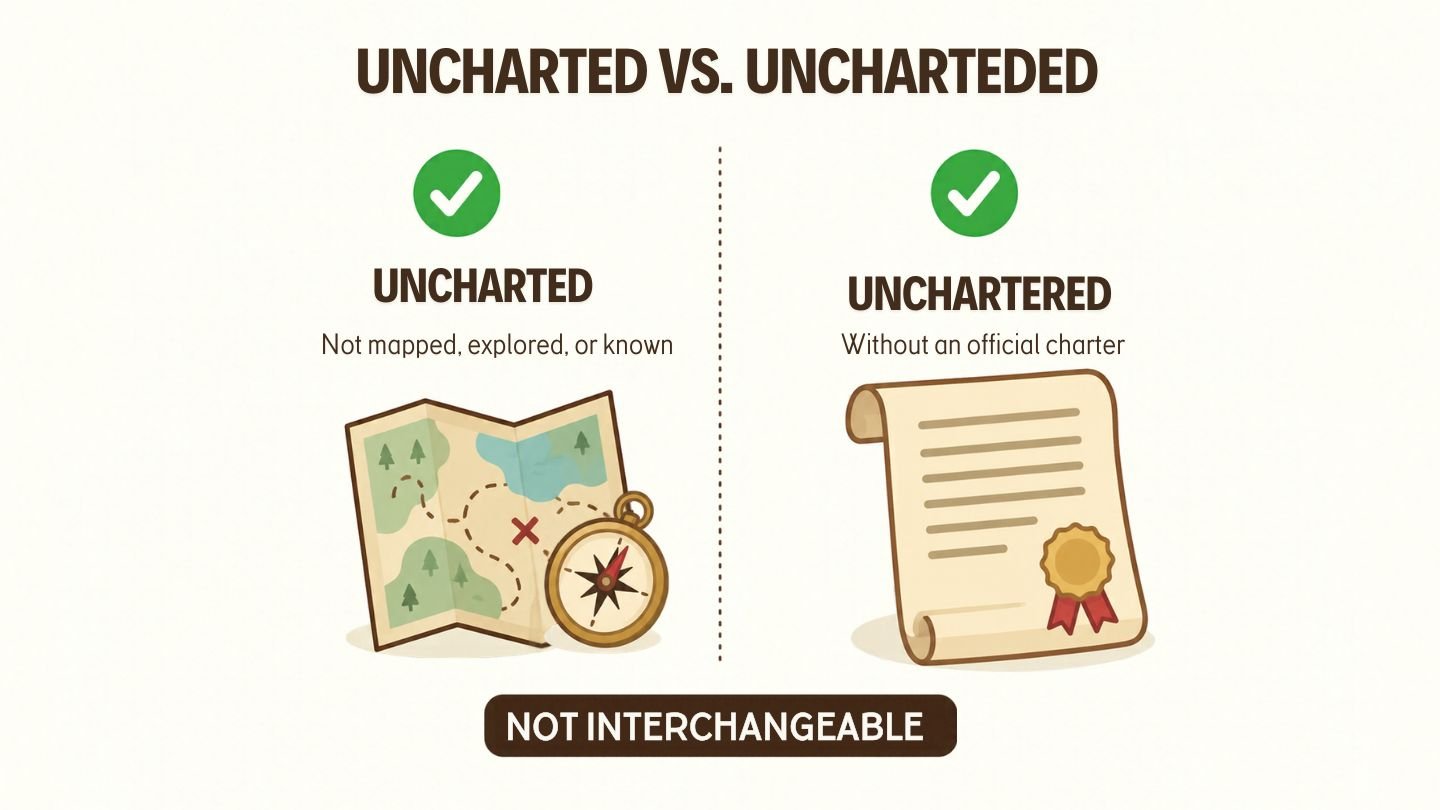
Uncharted and unchartered look almost identical, but they have different meanings. In most everyday situations, uncharted is the word you want, especially when talking about something unexplored, unknown, or not yet fully understood.
Unchartered is a real word, but it is much less common. It refers to something that has not been given or established under a charter, a formal document that creates or grants rights to an organization.
In this guide, you’ll learn the difference between uncharted or unchartered, when to use each word, common mistakes, examples, and an easy way to remember the correct spelling.
Uncharted or Unchartered (Quick Answer)
Uncharted is the correct choice when you mean unknown, unexplored, or not yet investigated.
- The explorers entered uncharted territory.
- She was entering uncharted waters in her new career.
Unchartered means not established, authorized, or granted under a charter and is mainly used in specialized legal or organizational contexts.
Quick rule: If you mean “unknown or unexplored,” use uncharted.
Which One Should You Use?
For normal English writing and conversation, uncharted is overwhelmingly the more useful word.
Use uncharted when something has not been mapped, explored, studied, experienced, or understood. The word can describe physical places, ideas, situations, careers, technology, and many other things.
For example:
The scientists were exploring uncharted territory.
Here, uncharted territory means an area of knowledge that has not been explored or understood before.
Unchartered, on the other hand, relates to a charter. A charter is a formal document that establishes an organization, grants authority, or sets out certain rights and responsibilities.
The memorable takeaway
Unknown or unexplored = uncharted.
Not established by a charter = unchartered.
Difference Table
| Feature | Uncharted | Unchartered |
| Meaning | Unknown, unexplored, or unmapped | Not established or authorized by a charter |
| Usage | Very common | Rare and specialized |
| Grammar | Adjective | Adjective |
| Context | Travel, knowledge, experiences, science, life | Legal, organizational, institutional contexts |
| Frequency | Common in everyday English | Uncommon in everyday English |
| Everyday use | Yes | Usually no |
Meaning of Uncharted
Uncharted is an adjective meaning not mapped, explored, investigated, or fully understood.
The word originally developed from the idea of a geographical area that had not been recorded on a map. Over time, its meaning expanded so that it can describe unfamiliar experiences and areas of knowledge.
Common uses of uncharted
You can use uncharted literally for places:
- The sailors traveled through uncharted waters.
- The expedition entered an uncharted region.
- The explorers discovered an uncharted island.
You can also use it figuratively:
- Starting a business took him into uncharted territory.
- The researchers were working in an uncharted area of science.
- Becoming a parent was an uncharted experience for her.
The expression uncharted territory is especially common. It means a situation that is new, unfamiliar, or not well understood.
Uncharted in everyday English
You may hear or read uncharted in conversations about:
- New experiences
- Careers
- Science
- Technology
- Travel
- Relationships
- Business
- Personal challenges
For example:
Artificial intelligence is taking businesses into uncharted territory.
Here, the phrase does not refer to a physical map. It means businesses are dealing with a relatively new and unfamiliar situation.
Meaning of Unchartered

Unchartered is also an adjective, but its meaning is connected to the noun charter.
A charter can be a formal document that establishes an organization or gives it specific rights, powers, or authority. Therefore, unchartered can describe something that has not been formally established or authorized under a charter.
This word is much less common than uncharted.
For example:
The organization operated as an unchartered association.
In a specialized context, the writer may be distinguishing the organization from one that has been formally established under a charter.
Because unchartered is uncommon, many people assume it is simply an incorrect spelling of uncharted. However, it is a legitimate word when its specific meaning is intended.
Why Do People Confuse These Words?
The confusion comes mainly from their similar spelling and pronunciation.
Both words begin with un- and contain charted or chartered, so it is easy to mix them up.
The important difference is the base word:
- chart → uncharted
- charter → unchartered
A chart can be a map or a record used to show information. Something that is uncharted has not been mapped, recorded, or explored.
A charter is a formal document or authorization. Something described as unchartered relates to the absence of such a charter.
This is why uncharted is the right spelling in familiar expressions such as uncharted waters and uncharted territory.
Grammar Rule
Both uncharted and unchartered function primarily as adjectives.
| Word | Base word | Basic idea |
| Uncharted | Chart | Not mapped, explored, or recorded |
| Unchartered | Charter | Not established or authorized by a charter |
The most important distinction is not a general spelling rule. It is a difference in the words they are formed from.
Compare these examples
Chart:
The coastline was carefully charted.
Uncharted:
The ship entered uncharted waters.
Charter:
The organization received a charter.
Unchartered:
The group remained unchartered.
If you are describing something unfamiliar or unexplored, uncharted is almost certainly the word you need.
Real-Life Examples
People
After leaving her longtime job, Maria found herself in uncharted territory.
This means she was facing an unfamiliar stage of life.
Nature
The expedition traveled through an uncharted section of the rainforest.
Here, uncharted has its literal sense: the area had not been properly mapped or explored.
Technology
The company was entering uncharted territory with its new technology.
The technology created a new or unfamiliar situation.
Business
The sudden economic changes pushed many businesses into uncharted territory.
The phrase means businesses faced conditions they had little previous experience with.
Everyday English
Moving to another country alone was uncharted territory for him.
This means the experience was completely new and unfamiliar.
Specialized organizational context
The club was described as unchartered under the relevant organizational framework.
Here, unchartered refers specifically to charter status rather than to exploration.
Common Mistakes
Mistake 1: Using “unchartered” for unexplored places
❌ The explorers entered unchartered territory.
✅ The explorers entered uncharted territory.
Why? The sentence describes territory that had not been explored or mapped, so uncharted is correct.
Mistake 2: Writing “uncharted” when discussing a charter
❌ The organization was uncharted by the governing body.
✅ The organization was unchartered.
Why? If the intended meaning concerns whether an organization has been established or authorized by a charter, unchartered may be appropriate.
Mistake 3: Assuming “unchartered” is always wrong
❌ Unchartered is never a real word.
✅ Unchartered is a real but uncommon word related to charters.
The word exists, but it is not normally the word you want when describing something unknown or unexplored.
Easy Memory Trick
Use this simple trick:
CHART = MAP → UNCHARTED = UNEXPLORED
Think of a chart as a map. If an area has not been put on the map, it is uncharted.
Then remember:
CHARTER = FORMAL AUTHORITY → UNCHARTERED = WITHOUT A CHARTER
So:
Uncharted = not on the map.
Unchartered = not under a charter.
If you remember only one thing, remember “chart = map.”
Mini Quiz
1. The researchers were entering ______ territory.
A. unchartered
B. uncharted
C. both, always
Answer: B. uncharted
The territory was unfamiliar and unexplored.
2. The sailors crossed ______ waters.
A. uncharted
B. unchartered
C. chartered
Answer: A. uncharted
“Uncharted waters” is the standard expression for waters that have not been mapped or explored.
3. Which word relates to a formal charter?
A. Uncharted
B. Unchartered
C. Charted
Answer: B. unchartered
Unchartered is connected with charter.
4. Starting his own company put him in ______ territory.
A. uncharted
B. unchartered
C. both
Answer: A. uncharted
The phrase means he was facing a new and unfamiliar situation.
Summary Table
| Situation | Correct word |
| An unexplored island | Uncharted |
| Unknown scientific area | Uncharted |
| Unfamiliar career experience | Uncharted |
| Unmapped waters | Uncharted |
| Unfamiliar business situation | Uncharted |
| Something relating to charter status | Unchartered |
| An organization without a formal charter | Unchartered |
| The common phrase “___ territory” | Uncharted territory |
| The common phrase “___ waters” | Uncharted waters |
Frequently Asked Questions (FAQs)
Is “uncharted” or “unchartered” correct?
Both are legitimate words, but they have different meanings. Uncharted means unknown, unexplored, or unmapped, while unchartered relates to something not established or authorized by a charter.
Is it “uncharted territory” or “unchartered territory”?
The standard expression is uncharted territory. It means an unfamiliar or unexplored situation.
The new technology has taken us into uncharted territory.
Is it “uncharted waters” or “unchartered waters”?
The correct and widely used phrase is uncharted waters. It can refer literally to unmapped waters or figuratively to a new and uncertain situation.
Is “unchartered” a real word?
Yes. Unchartered is a real word, but it is uncommon. It is related to the word charter and is used in specialized contexts involving formal organizational or legal status.
What does “uncharted” mean?
Uncharted means not mapped, explored, investigated, or fully understood. It can describe both physical places and unfamiliar experiences.
What is the difference between “charted” and “chartered”?
Charted means mapped, recorded, or plotted. Chartered is related to a charter, which is a formal document granting rights, authority, or establishing an organization.
Is “uncharted” more common than “unchartered”?
Yes. Uncharted is far more common in modern everyday English. It frequently appears in expressions such as uncharted territory and uncharted waters.
Which word should English learners use?
If you mean unknown, unfamiliar, unexplored, or unmapped, choose uncharted. Use unchartered only when the context specifically involves a charter.
Conclusion
The difference between uncharted and unchartered is small in spelling but important in meaning.
Uncharted means something is unexplored, unmapped, unknown, or unfamiliar. It is the word used in common expressions such as uncharted territory and uncharted waters.
Unchartered is much less common and relates to a charter, especially in specialized organizational or legal contexts.
The easiest rule to remember is:
If it means “not on the map” or “not yet explored,” use uncharted. If it concerns a formal charter, unchartered may be the right word.

I am William Carter, an English language writer with a passion for grammar, vocabulary, and effective communication. I enjoy explaining confusing English words, spelling differences, grammar rules, and everyday language usage in simple and easy-to-understand ways.
Through my articles, I aim to help readers improve their English writing and communication skills. I focus on providing clear explanations, practical examples, and useful writing tips.
I also enjoy reading language books, exploring new vocabulary, and learning more about the English language.
My Books:
- The Complete Guide to English Grammar
- Commonly Confused English Words
- Improve Your English Writing Skills