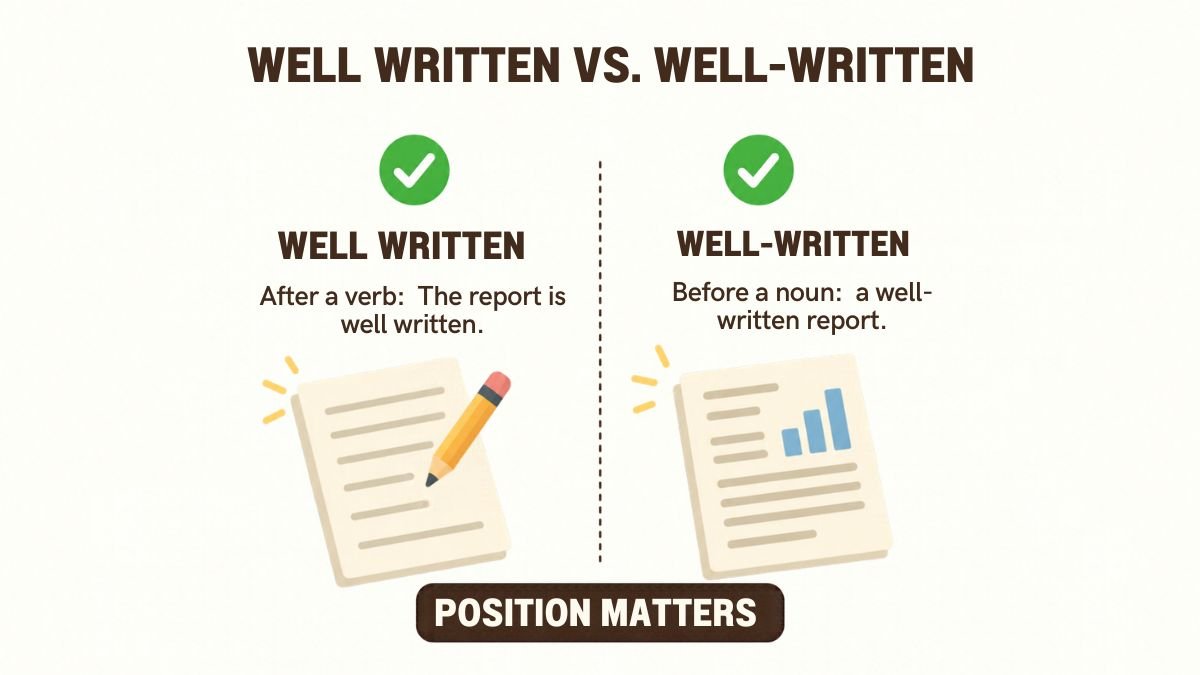
If you are unsure whether to write “well written” or “well-written,” you are not alone. Both forms are correct, but the choice depends mainly on where the expression appears in a sentence and how it functions grammatically.
In general, use well-written when the words come together as a compound adjective before a noun: a well-written article. Use well written when the phrase comes after a linking verb: The article is well written. This guide explains the rule, common mistakes, examples, and an easy way to remember the difference.
Quick Answer
“Well-written” is usually used before a noun as a compound adjective: “She submitted a well-written essay.”
“Well written” is commonly used after a linking verb such as is, was, or seems: “Her essay is well written.”
The simple rule is: Before a noun, hyphenate; after a linking verb, usually leave out the hyphen.
Which One Should You Use?
Both well written and well-written can be correct. The difference is grammatical rather than a difference in meaning.
Use well-written when well and written work together to describe a noun that follows:
- a well-written book
- a well-written report
- a well-written email
- a well-written story
Use well written when the phrase follows a linking verb and describes the subject:
- The book is well written.
- Her report was well written.
- The email looks well written.
A useful takeaway
Before a noun: “well-written.” After a linking verb: usually “well written.”
Difference Table
| Feature | Well-written | Well written |
| Meaning | Written skillfully or effectively | Written skillfully or effectively |
| Usage | Usually before a noun | Usually after a linking verb |
| Grammar | Compound adjective | Adverb + past participle |
| Context | Describes a noun directly | Describes the subject after a linking verb |
| Frequency | Very common before nouns | Very common after is, was, seems, etc. |
| Everyday use | “a well-written article” | “The article is well written” |
Meaning of “Well-Written”
Well-written means that something has been written effectively, clearly, skillfully, or attractively.
It is a compound adjective made from well + written. When it comes directly before a noun, the hyphen helps show that the two words work together as one descriptive unit.
Common uses
You might describe these as well-written:
- a well-written novel
- a well-written article
- a well-written speech
- a well-written review
- a well-written email
- a well-written business proposal
Examples
- She published a well-written article about climate change.
- He gave me a well-written report.
- The teacher praised her well-written essay.
- We received a well-written complaint from the customer.
In each example, well-written comes immediately before the noun it describes.
Meaning of “Well Written”

Well written has essentially the same meaning, but it is commonly written without a hyphen when it follows a linking verb.
Here, well functions as an adverb modifying written, while written describes the subject.
Examples
- The article is well written.
- Her essay was well written.
- This book is surprisingly well written.
- The report seems well written.
- Your message is very well written.
Notice that the expression comes after verbs such as is, was, and seems.
Why is there no hyphen?
The hyphen is generally used when two words combine to modify a noun as a unit before that noun. After a linking verb, that same compound modifier usually does not need a hyphen.
Compare:
She wrote a well-written article.
The article is well written.
The meaning is nearly identical, but the grammatical position changes.
Why Do People Confuse These Words?
The confusion happens because well written and well-written sound exactly the same when spoken.
The only visible difference is the hyphen. Writers may also see both forms in books, websites, emails, and other writing and wonder whether one is a spelling mistake.
The important point is that the hyphen is not changing the meaning. It is helping show the grammatical relationship between the words.
This is a common issue with compound adjectives in English. Similar patterns include:
- a well-known author → The author is well known.
- a high-quality product → The product is high quality.
- a long-term plan → The plan is long term.
- a full-time employee → She works full time.
Grammar Rule
When well + past participle forms a compound adjective directly before a noun, a hyphen is normally used.
| Position | Example | Preferred form |
| Before a noun | a ___ article | a well-written article |
| After a linking verb | The article is ___ | The article is well written |
| Before a noun | a ___ book | a well-written book |
| After a linking verb | The book was ___ | The book was well written |
Compare these sentences
Before the noun:
- We read a well-written novel.
- She prepared a well-written proposal.
- He submitted a well-written application.
After the verb:
- The novel was well written.
- Her proposal was well written.
- His application was well written.
What about other sentence positions?
The expression can also appear in structures where the exact hyphenation depends on style and grammatical construction.
For example:
- The author writes well.
- The article was very well written.
- This is a very well-written article.
Notice that well by itself does not need a hyphen when it simply functions as an adverb:
She writes well.
But when well-written directly modifies article, it forms a compound adjective:
She wrote a well-written article.
Real-Life Examples
People
- She is a well-written character in the novel.
- The author created a believable and well-written character.
- The character is well written and easy to understand.
Nature
- The documentary contains a well-written description of the natural environment.
- The article about wildlife is well written.
Technology
- This website has a well-written help guide.
- The software documentation is well written and easy to follow.
- We need a well-written user manual.
Business
- The company sent a well-written proposal to the client.
- His business report was well written.
- She prepared a well-written presentation for the meeting.
Everyday English
- That was a well-written email.
- Your message is well written.
- I just finished reading a well-written story.
- The instructions are well written and easy to follow.
Common Mistakes
Mistake 1: Using no hyphen before a noun
❌ She wrote a well written article.
✅ She wrote a well-written article.
When the expression directly modifies article, the hyphen makes the compound adjective clear.
Mistake 2: Automatically adding a hyphen after a linking verb
❌ The article is well-written.
✅ The article is well written.
The unhyphenated form is generally preferred when the phrase follows the linking verb is.
Mistake 3: Hyphenating “well” with every verb
❌ She well-writes her essays.
✅ She writes well.
Here, well is simply an adverb describing how she writes. It is not part of a compound adjective.
Mistake 4: Confusing “well-written” with “good writing”
Well-written describes the quality of the writing.
- The essay is well written.
Good writing is a noun phrase.
- The essay contains good writing.
Both can be correct, but they have different grammatical structures.
Easy Memory Trick
Use this simple test:
Look at the word immediately after “well-written.”
If a noun comes next, use the hyphen:
a well-written book
If there is a linking verb before the phrase, usually remove the hyphen:
The book is well written.
Think:
Before noun = BUILD the adjective → well-written
After verb = DESCRIBE the subject → well written
This trick also works with many similar compound adjectives.
Mini Quiz
1. Which sentence is correct?
A. She wrote a well written report.
B. She wrote a well-written report.
Answer: B.
Well-written comes directly before the noun report, so the compound adjective is normally hyphenated.
2. Choose the correct form:
The report was ___.
A. well-written
B. well written
Answer: B.
After the linking verb was, the usual form is well written.
3. Which sentence is correct?
A. He submitted a well-written application.
B. He submitted a well written application.
Answer: A.
The compound adjective comes before application, so well-written is the standard choice.
4. Which sentence uses “well” correctly?
A. She well-writes her assignments.
B. She writes well.
Answer: B.
Here, well is an adverb modifying the verb writes, so no hyphen is needed.
Summary Table
| Situation | Correct form | Example |
| Before a noun | well-written | a well-written essay |
| Before a noun | well-written | a well-written book |
| After is | well written | The essay is well written. |
| After was | well written | The book was well written. |
| After seems | well written | The article seems well written. |
| With the verb write | write well | She writes well. |
| With a noun phrase | good writing | He produces good writing. |
Frequently Asked Questions (FAQs)
Is “well written” grammatically correct?
Yes. Well written is grammatically correct, especially when it follows a linking verb such as is, was, or seems: The article is well written.
Is “well-written” grammatically correct?
Yes. Well-written is correct when it functions as a compound adjective before a noun: She wrote a well-written article.
Is it “well written” or “well-written article”?
The standard form is well-written article because the compound adjective comes directly before the noun article.
Is it “the book is well written” or “the book is well-written”?
The book is well written is the usual form. The phrase follows the linking verb is, so the hyphen is generally omitted.
Can I write “very well-written”?
Yes. Before a noun, you can write a very well-written article. The hyphen connects well and written as part of the compound adjective.
After a linking verb, write:
The article is very well written.
Is “well-written” hyphenated in American English?
Yes, when it functions as a compound adjective before a noun. American English commonly uses well-written article, while well written is normally used after a linking verb.
Is “well-written” hyphenated in British English?
British English also commonly uses well-written before a noun and well written after a linking verb. Individual style guides may differ in some cases, but the basic distinction is widely recognized.
Is “well written” one word?
No. Well written consists of two separate words. When the words form a compound adjective before a noun, they are normally connected with a hyphen: well-written.
Conclusion
Well written and well-written have the same basic meaning, but their punctuation depends on how they are used in a sentence.
Use well-written when the compound adjective comes before a noun: a well-written article. Use well written when the phrase follows a linking verb: The article is well written.
The easiest rule to remember is: before a noun, use “well-written”; after a linking verb, usually use “well written.”

I am Daniel Brooks, a passionate English language writer specializing in grammar, vocabulary, spelling, and language education. I love breaking down complicated grammar concepts into simple explanations that readers can easily understand.
My goal is to help students, bloggers, and everyday English users improve their writing and communication skills. I create helpful articles about commonly confused words, correct spelling, sentence structure, punctuation, and English expressions.
In my free time, I enjoy reading educational books, exploring new words, and researching different aspects of the English language.
My Books:
- Mastering Everyday English Grammar
- The English Vocabulary Handbook
- Better Writing Through Better Grammar