
Nonfiction and non-fiction are both correct spellings. They refer to writing or other works based on real people, facts, events, or information rather than invented stories. The main difference is style and spelling preference, not meaning.
In American English, nonfiction is generally the more common modern spelling, especially in publishing, education, and everyday writing. Non-fiction is also acceptable and remains common, particularly in British English and in some publishing styles.
This guide explains when to use nonfiction or non-fiction, why both forms exist, how the prefix non- works, and which spelling is usually the safest choice.
Quick Answer
Nonfiction and non-fiction are both correct. Nonfiction is usually the preferred spelling in modern American English, while non-fiction is also widely used, especially in British English and certain style guides.
- I enjoy reading nonfiction books.
- The library has a large non-fiction section.
The important point is that nonfiction is not a different word from non-fiction. They have the same meaning; the difference is simply whether the word is written as one word or with a hyphen.
Which One Should You Use?
If you are writing for a U.S. audience, nonfiction is generally the best choice.
Use nonfiction when referring to books, literature, writing, or other material based on factual information:
She writes nonfiction about American history.
I prefer nonfiction to fantasy novels.
Non-fiction is not wrong. You may encounter it in British publications, older books, editorial styles, or publications that prefer hyphenated compounds.
The safest everyday choice
For most modern American writing, choose nonfiction.
Memorable takeaway: Nonfiction is the usual American spelling; non-fiction is an accepted variant.
Difference Table
| Feature | Nonfiction | Non-fiction |
| Meaning | Writing based on facts or reality | Writing based on facts or reality |
| Usage | Very common | Also correct and widely used |
| Grammar | Noun or adjective | Noun or adjective |
| Context | Books, publishing, education, journalism | Books, publishing, education, journalism |
| Frequency | Generally preferred in modern U.S. usage | Common in some British and editorial styles |
| Everyday use | Recommended for most American writing | Acceptable alternative |
Meaning of Nonfiction
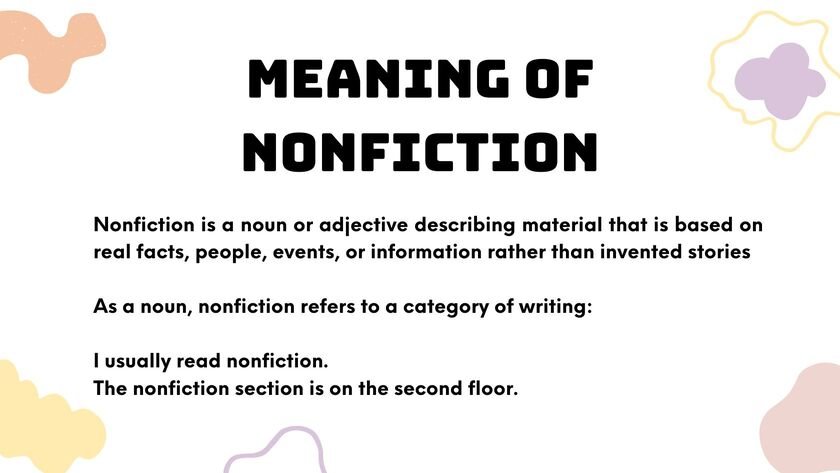
Nonfiction is a noun or adjective describing material that is based on real facts, people, events, or information rather than invented stories.
As a noun, nonfiction refers to a category of writing:
I usually read nonfiction.
The nonfiction section is on the second floor.
As an adjective, it describes something that belongs to this category:
She published a nonfiction book about World War II.
He is taking a nonfiction writing class.
Nonfiction includes many different types of writing, such as:
- Biographies
- Autobiographies
- Memoirs
- History books
- News writing
- Essays
- Scientific books
- Self-help books
- Travel writing
- Documentaries and other factual works
The word does not mean that every detail is necessarily perfect or that the writer has no personal opinions. It means the work is presented as factual or based on reality, rather than as an invented fictional story.
Meaning of Non-Fiction
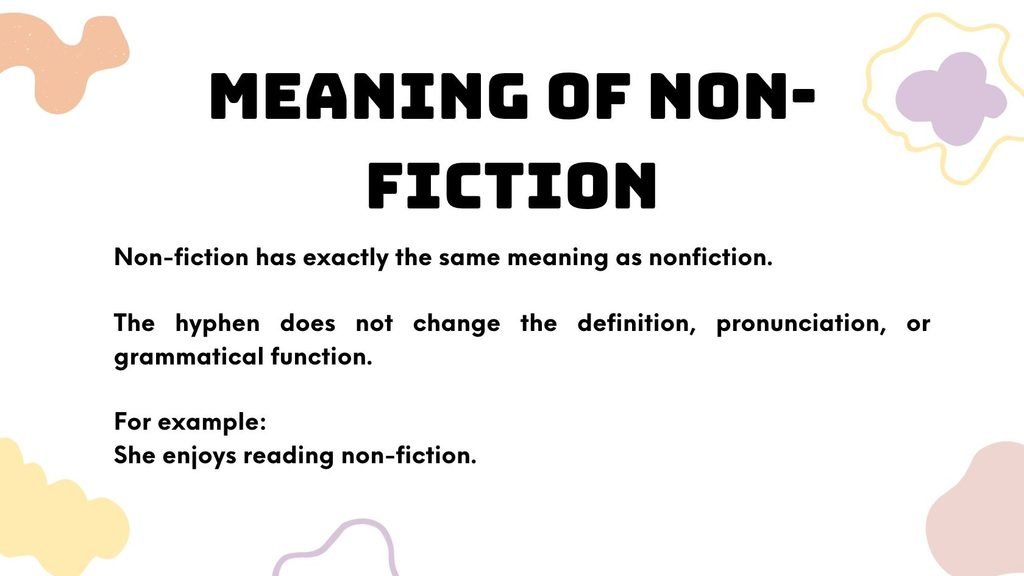
Non-fiction has exactly the same meaning as nonfiction.
The hyphen does not change the definition, pronunciation, or grammatical function.
For example:
She enjoys reading non-fiction.
He writes non-fiction for a living.
The bookstore has a separate non-fiction section.
The spelling is simply a hyphenated form of the same word.
Why is the hyphen used?
English has many compounds whose spelling has changed over time. A combination that was once written with a hyphen can eventually become a closed compound written as one word.
This is why you can find both non-fiction and nonfiction in published English.
Why Do People Confuse These Words?
The confusion comes from the prefix non-.
The prefix non- generally means not or the absence of something. When it is added to another word, English spelling conventions do not always produce the same result.
For example:
- nonessential
- nonprofit
- nonverbal
- nonresident
- nonstandard
But some compounds may traditionally appear with a hyphen, depending on the word, publication, or style guide.
Because fiction is a complete word, writers sometimes naturally choose non-fiction to make the two parts visually clear. Other writers use the increasingly common closed form nonfiction.
Both spellings communicate the same idea.
Grammar Rule
There is no grammar rule saying that nonfiction is correct while non-fiction is incorrect.
The difference is primarily orthographic and stylistic.
| Form | Function | Example |
| nonfiction | Noun | I enjoy nonfiction. |
| nonfiction | Adjective | She wrote a nonfiction book. |
| non-fiction | Noun | I enjoy non-fiction. |
| non-fiction | Adjective | She wrote a non-fiction book. |
American vs. British English
Spelling preferences can vary between American and British English, but the distinction is not absolute.
American publishers and dictionaries commonly use nonfiction as the closed form. British English also uses non-fiction, although nonfiction is found in British usage as well.
Therefore, it is better to think of this as a style preference, rather than a strict American-versus-British grammar rule.
If you are writing for a specific publication, follow that publication’s style guide consistently.
Real-Life Examples
People
My sister enjoys reading nonfiction about famous scientists.
The author specializes in non-fiction biographies.
Both sentences are correct.
Nature
I bought a nonfiction book about marine life.
The library has several non-fiction books about birds.
Both forms describe factual books about the natural world.
Technology
He reads nonfiction books about artificial intelligence and computers.
She is interested in non-fiction writing about technological change.
Business
The bookstore recently expanded its nonfiction section.
The publisher specializes in non-fiction titles.
Everyday English
What kind of books do you like?
I mostly read nonfiction.
This is a particularly natural use of the closed spelling in American English.
Common Mistakes
Mistake 1: Treating one spelling as completely wrong
❌ Non-fiction is incorrect.
✅ Non-fiction is an accepted spelling of nonfiction.
The hyphenated form is not a spelling error.
Mistake 2: Assuming the hyphen changes the meaning
❌ Nonfiction means factual books, but non-fiction means something different.
✅ Nonfiction and non-fiction have the same meaning.
The hyphen does not create a different category of literature.
Mistake 3: Mixing styles unnecessarily
❌ The nonfiction section contains several non-fiction books, and the author writes nonfiction.
✅ The nonfiction section contains several nonfiction books, and the author writes nonfiction.
The first sentence is not grammatically wrong, but consistent spelling is usually cleaner.
Mistake 4: Assuming all books are nonfiction because they are real
❌ A novel based on a real historical person is automatically nonfiction.
✅ A novel based on a real person can still be fiction.
A work is generally classified according to whether it is presented as factual or as an invented narrative. A fictional story can use real people, places, or historical events.
Easy Memory Trick
Think of nonfiction as “not fiction.”
If you are talking about writing based on real facts rather than an invented story, you need:
non + fiction = nonfiction
For American English, remember:
No fiction? Use nonfiction.
The hyphen in non-fiction does not change the meaning, so you can recognize both forms without worrying that one represents a different word.
Mini Quiz
1. Which spelling is generally preferred in modern American English?
A. Non-fiction
B. Nonfiction
C. Non ficton
Answer: B. Nonfiction
2. Which sentence is correct?
A. I enjoy reading nonfiction.
B. I enjoy reading non fiction.
C. I enjoy reading nonficton.
Answer: A. I enjoy reading nonfiction
Non-fiction would also be acceptable, but nonfiction is the usual closed form in American English.
3. Do nonfiction and non-fiction have different meanings?
A. Yes
B. No
C. Only when they describe books
Answer: B. No
They are spelling variants with the same meaning.
4. Which sentence is correctly written?
A. She wrote a nonfiction biography.
B. She wrote a non fiction biography.
C. She wrote a nonficton biography.
Answer: A. She wrote a nonfiction biography
The hyphenated form non-fiction biography would also be acceptable.
Summary Table
| Situation | Recommended form |
| Modern American English | nonfiction |
| Referring to factual books | nonfiction |
| Referring to factual writing | nonfiction |
| British or house style that uses hyphens | non-fiction |
| Formal writing for a specific publication | Follow its style guide |
| Meaning of both forms | Factual or reality-based work |
| Is non-fiction wrong? | No |
| Is nonfiction wrong? | No |
Frequently Asked Questions (FAQs)
Is nonfiction one word or two words?
Nonfiction is one word. It is also commonly written non-fiction with a hyphen. It is not normally written as two separate words, non fiction.
Is nonfiction or non-fiction correct?
Both are correct. They have the same meaning. Nonfiction is generally the preferred form in modern American English, while non-fiction remains widely used.
Is nonfiction one word in American English?
Yes. Nonfiction is the standard closed spelling commonly used in American English.
Is non-fiction British English?
Non-fiction is a common British spelling, but it is not exclusively British. Both British and American publications can use either form depending on their editorial style.
Should I write nonfiction or non-fiction in an essay?
If you are writing an American English essay and have no specific style requirement, nonfiction is a safe choice. If your school, publisher, or style guide uses non-fiction, follow that preference consistently.
What is the difference between nonfiction and fiction?
Fiction is generally invented storytelling, while nonfiction presents itself as factual or based on real people, events, or information. A nonfiction book can still contain analysis, interpretation, or the author’s opinions.
Is non fiction grammatically correct?
Usually, non fiction without a hyphen is not the preferred standard spelling. Use nonfiction or non-fiction instead.
Should I use a hyphen in nonfiction?
Not usually in modern American English. Nonfiction is generally written as one word. However, non-fiction is an accepted alternative, so the hyphenated form is not inherently incorrect.
Conclusion
Nonfiction and non-fiction mean the same thing. Both refer to writing or other works based on real facts, people, events, or information rather than invented stories.
For most American English writing, nonfiction is the simplest and most natural choice. Non-fiction is also correct and may be preferred by certain British publications, publishers, or style guides.
The easiest rule to remember is:
Use “nonfiction” as the default in American English, but recognize “non-fiction” as a correct alternative.

I am Daniel Brooks, a passionate English language writer specializing in grammar, vocabulary, spelling, and language education. I love breaking down complicated grammar concepts into simple explanations that readers can easily understand.
My goal is to help students, bloggers, and everyday English users improve their writing and communication skills. I create helpful articles about commonly confused words, correct spelling, sentence structure, punctuation, and English expressions.
In my free time, I enjoy reading educational books, exploring new words, and researching different aspects of the English language.
My Books:
- Mastering Everyday English Grammar
- The English Vocabulary Handbook
- Better Writing Through Better Grammar