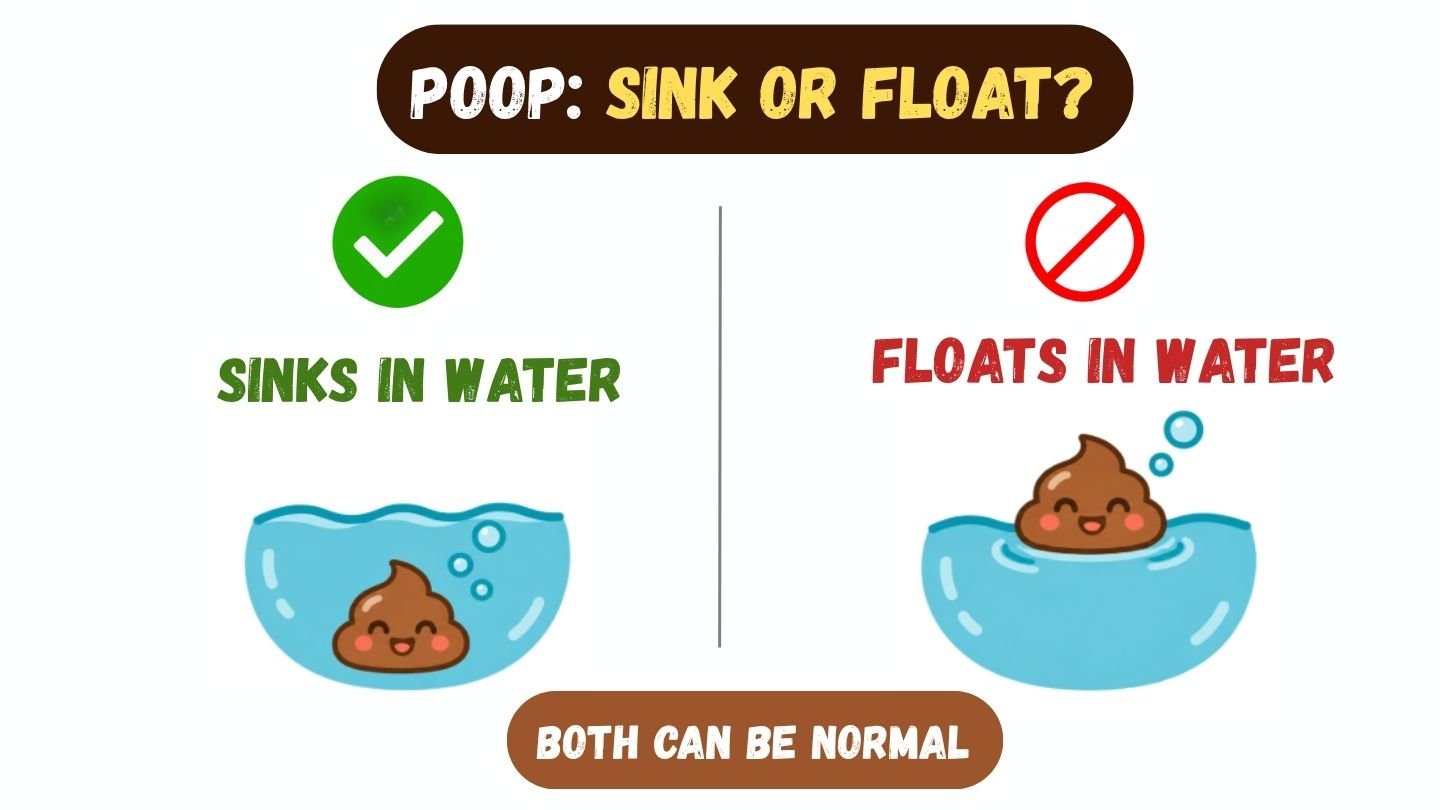
If you have ever wondered whether poop should sink or float, you are not alone. Stool can either sink to the bottom of the toilet or float on the water, and the difference is usually related to what is inside the stool.
In most cases, sinking poop is normal, and occasional floating poop is also normal. Floating stool may happen because of extra gas, changes in diet, or, less commonly, problems affecting how your body digests or absorbs fat.
This guide explains what sinking and floating poop can mean, when each is normal, and when a change in stool deserves medical attention.
Quick Answer
Healthy poop can sink or float. Stool usually sinks when it is relatively dense, while floating poop often contains more gas or, less commonly, excess fat.
An occasional floating bowel movement is usually not a concern. However, persistent floating stool accompanied by greasy, pale, foul-smelling, or difficult-to-flush poop may be worth discussing with a healthcare professional.
Examples:
- “My poop sank today.” → Usually completely normal.
- “My poop has been floating and looks greasy for several weeks.” → A medical evaluation may be appropriate.
Which One Should You Use?
If you are asking “Should poop sink or float?”, there is no single correct answer.
Poop commonly sinks because stool is denser than water. However, stool can float when it contains more trapped gas. Diet can also temporarily change stool characteristics.
The important point is that whether poop sinks or floats by itself is usually less important than its overall appearance, consistency, smell, frequency, and whether you have other symptoms.
A one-time floating bowel movement is generally not something to worry about.
Memorable takeaway: Sink or float alone usually tells you less than the whole picture of your stool and how you feel.
Difference Table
| Feature | Poop That Sinks | Poop That Floats |
| Meaning | Usually denser stool | Often more gas in the stool |
| Common cause | Normal stool composition | Gas, diet, or other factors |
| Grammar | “The poop sinks.” | “The poop floats.” |
| Context | Common everyday observation | Common occasional observation |
| Frequency | Very common | Can happen occasionally |
| Everyday concern | Usually none | Usually none if occasional |
| When to pay attention | Major changes or other symptoms | Persistent change plus other symptoms |
Meaning of Word 1: Sink
Definition
Sink means to move downward through water or another liquid until something reaches a lower position.
When we say “poop sinks,” we mean that the stool drops below the surface of the toilet water.
For example:
- “The stool sank to the bottom of the toilet.”
- “My poop usually sinks.”
- “Why does some poop sink while other poop floats?”
Grammar Role
Sink is a verb.
Its common forms are:
- Present: sink
- Past: sank
- Past participle: sunk
Examples:
- “The stool sinks.”
- “The stool sank yesterday.”
- “The stool has sunk to the bottom.”
The word sink can also describe objects other than stool:
- “The boat began to sink.”
- “The stone sank in the pond.”
- “The coin sank to the bottom.”
Meaning of Word 2: Float
Definition
Float means to remain on or near the surface of a liquid rather than moving downward.
When people say “my poop floats,” they mean that the stool remains on top of the toilet water.
Examples:
- “My poop floated this morning.”
- “Sometimes my stool floats.”
- “The stool was floating on the water.”
Grammar Role
Float is also a verb.
Its forms are:
- Present: float
- Past: floated
- Past participle: floated
Examples:
- “The stool floats.”
- “The stool floated yesterday.”
- “The stool has floated several times.”
Unlike sink, the past tense of float simply adds -ed.
Why Do People Confuse These Words?
People often search for “poop sink or float” because they want to know which type of stool is considered normal.
The confusion comes from the idea that one must be healthier than the other. In reality, both sinking and floating stool can occur normally.
The physical difference is mainly about density and what is contained in the stool. Gas can make stool less dense, allowing it to float.
Food can also influence bowel movements. A temporary change in diet, particularly a change involving foods that affect digestion or intestinal gas, can sometimes change whether stool sinks or floats.
The key is not to judge your health based on one bowel movement.
Grammar Rule
If you are using sink and float in English, remember that both are verbs describing movement or position in liquid.
| Verb | Present | Past | Example |
| Sink | sink/sinks | sank | “The stool sank.” |
| Float | float/floats | floated | “The stool floated.” |
Similar Examples
The same pattern works with ordinary objects:
- “The rock sinks.”
- “The leaf floats.”
- “The boat sank.”
- “The balloon floated away.”
For a singular subject such as poop or stool, use sinks or floats in the simple present:
- “My poop sinks.”
- “My poop floats.”
For general statements, you can also say:
- “Poop can sink or float.”
- “Stool may sink or float.”
Real-Life Examples
People
“My poop usually sinks, but it floated today.”
This can happen occasionally and does not automatically mean that something is wrong.
Nature
The same English verbs are used for natural objects:
- “A stone sinks in water.”
- “A leaf floats on water.”
- “A branch may float down a river.”
These examples can help English learners understand the difference between sink and float.
Everyday English
People commonly use both words when talking about water:
- “The toy sank.”
- “The ball floated.”
- “The boat is floating.”
- “The keys sank to the bottom.”
The expressions “sinking stool” and “floating stool” are understandable everyday descriptions.
Common Mistakes
Mistake 1: Treating floating poop as automatically unhealthy
❌ “Floating poop always means you are sick.”
✅ “Floating poop can happen for several reasons and is not necessarily a sign of illness.”
An occasional floating bowel movement is often harmless.
Mistake 2: Assuming poop must always sink
❌ “Healthy poop has to sink.”
✅ “Healthy stool can sink or occasionally float.”
There is no universal rule that every healthy bowel movement must sink.
Mistake 3: Using the wrong past tense of sink
❌ “My poop sinked yesterday.”
✅ “My poop sank yesterday.”
Sinked is not the standard past tense. The correct past tense is sank.
Mistake 4: Confusing sank and sunk
❌ “The stool has sank.”
✅ “The stool has sunk.”
Use sank as the simple past and sunk after helping verbs such as has, have, or had.
- “It sank yesterday.”
- “It has sunk already.”
Easy Memory Trick
Use this simple image in your mind:
SINK = DOWN
FLOAT = UP
Think of a heavy rock and a light balloon.
- A rock sinks.
- A balloon floats.
When talking about poop, the same basic idea applies: stool that is denser tends to sink, while stool containing more gas may float.
For English grammar, remember:
Sink → sank → sunk
Float → floated → floated
Mini Quiz
1. Which sentence is correct?
A. “The stool sinked yesterday.”
B. “The stool sank yesterday.”
C. “The stool sunk yesterday.”
Answer: B.
The simple past tense of sink is sank.
2. Which sentence is correct?
A. “My poop floats today.”
B. “My poop float today.”
C. “My poop floating today.”
Answer: A.
With singular poop, the present-tense verb is floats.
3. Which statement is most accurate?
A. Healthy poop must always sink.
B. Healthy poop must always float.
C. Healthy poop can sink or occasionally float.
Answer: C.
Both can occur normally.
4. Which sentence uses “sunk” correctly?
A. “The stool has sunk.”
B. “The stool has sank.”
C. “The stool has sink.”
Answer: A.
Sunk is the past participle used with has, have, or had.
Summary Table
| Situation | Correct word/expression |
| Moving downward in water | Sink |
| Remaining on the surface | Float |
| Past tense of sink | Sank |
| Past participle of sink | Sunk |
| Past tense of float | Floated |
| Stool goes to the bottom | The poop sinks |
| Stool remains on top | The poop floats |
| Occasional floating poop | Usually not concerning by itself |
| Persistent floating poop with other changes | Consider speaking with a healthcare professional |
Frequently Asked Questions (FAQs)
Is it normal for poop to float?
Yes. Occasional floating poop can be normal, especially when extra gas is present in the stool. A single floating bowel movement usually does not indicate a health problem.
Is poop supposed to sink or float?
There is no requirement for healthy poop to do only one. Stool can normally sink or float. The overall pattern and any accompanying symptoms are more useful than whether it floats on one particular day.
Why does my poop float?
Floating stool can occur because it contains more gas, which makes it less dense. Diet and temporary digestive changes can also affect stool.
Is floating poop a sign of too much fat?
Not necessarily. Floating stool is often related to gas, but persistent floating stool that is greasy, oily, unusually pale, very foul-smelling, or difficult to flush can sometimes be associated with problems digesting or absorbing fat. If this continues, talk with a healthcare professional.
Is sinking poop healthier than floating poop?
No. Sinking does not automatically mean healthier, and floating does not automatically mean unhealthy. Stool characteristics should be considered together with symptoms and other changes in bowel habits.
Why does poop sometimes sink and sometimes float?
Your stool can change from one bowel movement to another because its composition changes. Differences in gas, food, water, and digestion can affect its density.
What does “sink” mean in “poop sink or float”?
Sink is a verb meaning to move downward through water. In this context, “the poop sinks” means the stool moves below the water’s surface.
What does “float” mean in “poop sink or float”?
Float means to remain on or near the surface of a liquid. “The poop floats” means the stool stays on top of the toilet water.
Conclusion
So, does poop sink or float? It can do either. Sinking stool is very common, while occasional floating stool can also be completely normal.
From an English perspective, sink means to move downward in water, while float means to remain on the surface. Their correct forms are sink → sank → sunk and float → floated → floated.
From a health perspective, do not assume that floating poop is automatically unhealthy. Pay more attention to persistent changes, especially if floating stool is accompanied by greasy or oily appearance, unusual color, strong odor, unexplained weight loss, abdominal symptoms, or other ongoing digestive problems.
Simple rule to remember: Poop can sink or float; occasional floating alone usually isn’t a reason to worry.

I am Daniel Brooks, a passionate English language writer specializing in grammar, vocabulary, spelling, and language education. I love breaking down complicated grammar concepts into simple explanations that readers can easily understand.
My goal is to help students, bloggers, and everyday English users improve their writing and communication skills. I create helpful articles about commonly confused words, correct spelling, sentence structure, punctuation, and English expressions.
In my free time, I enjoy reading educational books, exploring new words, and researching different aspects of the English language.
My Books:
- Mastering Everyday English Grammar
- The English Vocabulary Handbook
- Better Writing Through Better Grammar